Monday, 6 March 2017

Kohli lbw b Hazlewood - did DRS get it wrong?

Australia vs India, Day 3 of Test Match #2.

The match is at a critical situation. The series is in balance.

Hazlewood to Kohli. The ball is on target but keeps low and Hazlewood appeals for lbw. The on-field umpire rules Kohli out - he must have thought either Kohli didn't hit the ball or that he hit it after the ball had struck the pad.


Kohli thinks it was the bat that hit the ball first and asks for a review.

The Third umpire confirms bat hit the ball, but is not sure whether it hit the ball first. So, as the DRS rules prescribe, he says the replays are "inconclusive". He leaves the decision to the on-field umpire.

DRS rules 3.3 (k) and (l) say what must be done next: "The on-field umpire must then make his decision based on those factual questions that were answered by the third umpire, any other factual information offered by the third umpire and his recollection and opinion of the original incident. The on-field umpire will reverse his decision if the nature of the supplementary information received from the third umpire leads him to conclude that his original decision was incorrect."

Returning to the match situation, the on-field umpire now knows that even the third umpire, who has access to UltraEdge and slow-motion replays from many angles, is unable to conclude whether the batsman is out or not. How then could he be sure about his original decision? When the umpire is in doubt, he cannot rule a batsman out. But he sticks to his original decision and sends Kohli on his way. Rarely does an umpire reverse his decision. What does this tell us?

Sunday, 5 March 2017

Cricket and DRS

I was at the beach. Two guys came and settled down nearby with a pack of masala groundnuts. One of them seemed upset at how things had turned out for India in the cricket Test match against Australia. The other guy had a know-all look about him.

Small time player: Do we really need DRS?
Officer: Why not, we have the technology. On-field umpires need all the help they can get.

DRS - review in progress


P: Then why doesn't the umpire himself consult the third umpire for LBW etc.?
O: He isn't allowed to, except for a few decisions e.g. run out, clean catch etc.

P: He is responsible for his decision, isn't he?
O: hmmm...

P: Why should the team be docked for the umpire's decision... I mean reducing the number of reviews if their appeal for review is turned down.
O: Because you can't repeatedly question the umpire's decision... time is wasted and you know time is money.

P: Isn't DRS about getting better decisions?
O: Of course, that's why they spend around US$100,000 on it for a Test match.

P: How many credible appeals are made in 80 overs, or in a day, roughly?
O: I don't know... could be 20-30 on a wicket that produces a result.

P: And a team gets only two chances if the two reviews are unsuccessful?
O: Yes, the teams have to get their decisions right.

P: Isn't that why we have umpires?
O: hmmm...

P: I think you should let the umpires get help from the DRS umpire on their own. To limit the time taken, you could give the umpires and the teams one review every 10 overs.
O: Sure, I'll inform ICC if they ask me.

Officer had emptied the groundnuts and got up for a refill.

Monday, 30 January 2017

Ballpoint pens are are not recycled, use pens that can be refilled with ink

Throwaway ballpoint pens pose a serious environment problem. Billions are used and thrown away every year. These pens, and refills, are not recycled since it is difficult to separate the metal nib and ink from the plastic.

It isn't a secret that the ballpoint pen is the most popular type of pen. It uses a thick, oil-based ink that is dissolved in alcohol. As soon as you write, the alcohol evaporates, and so the ink dries up quickly. The ink does not bleed through paper and lasts long. But since the ink is thicker, the pen must be pressed harder on paper leading to greater stress on the hand and slower writing.

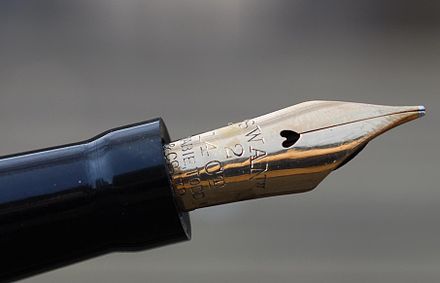
Fountain Pen


An environment-friendly alternative to ballpoint pen is the fountain pen - it is commonly available too. Some kids may find it difficult to write with the traditional nib since its angle with the paper must remain the same to ensure smooth writing. To get around this, use fountain pens that have roller balls at the tip instead of nibs. (Ballpoint pens too use roller balls; however, the ink used by roller ball  pens is thinner and so the flow is better.)

Fountain pen with nib (Wikipedia)
Roller ball pens use either water-based ink or a thicker gel ink (pigments on a water-based gel). Gel ink dries quicker. It also writes thicker but may skip/slip occasionally and bleed more.

Close-up shot of roller ball at the tip
(Wikipedia)
Some pens use removable cartridges that hold ink - the advantage is that students can carry a spare cartridge to school instead of an ink pot. When the cartridge in the pen runs out of ink, it can be replaced with the spare one. The empty cartridge can be refilled later at home. Throwing away a cartridge after using it once defeats the purpose of using refillable ink pens. (Also, don't buy pens with cartridges that cannot be refilled.)

If you travel by air with a fountain pen, the guaranteed way to prevent leakage is to empty the ink tank. Or, fill it up and keep it upright.  To use the pen, wait till the flight takes off and reaches 6000 feet, which is when cabin pressure is increased to match the pressure at ground level (the air trapped in the ink tank is at the pressure at ground level; if the pen is opened before the cabin is pressurized, the higher pressure of air in the tank will push out the ink since the pressure in the cabin would be lesser).

Popular posts